# What is the intended use case of the install command line option?
**URL:** https://discourse.cmake.org/t/what-is-the-intended-use-case-of-the-install-command-line-option/452
**Category:** Development
**Created:** [January 5, 2020, 11:24pm UTC](https://discourse.cmake.org/t/what-is-the-intended-use-case-of-the-install-command-line-option/452 "2020-01-05T23:24:42Z")
**Posts on this page:** 6
**Page:** 1
### Author:  [@CrustyAuklet](https://discourse.cmake.org/u/CrustyAuklet)
#### Post date: [January 5, 2020, 11:24pm UTC](https://discourse.cmake.org/t/what-is-the-intended-use-case-of-the-install-command-line-option/452/1 "2020-01-05T23:24:42Z")
What is the intended use case of the `cmake --install` command line option (or the older install target)?
I am wondering because it seems extremely cumbersome and hard to customize compared to CPack. The documentation states: `CMake provides a command-line signature to install an already-generated project binary tree`
I interpreted this to mean: Installing a project or library, from the command line, for power users/developers. So that without needed a package I can simply clone, build, and install a program/library.
If this is close to the intended use case, it seems like I should be able to operate on the `COMPONENTS` property as a variable and in similar ways as I can within CPack with `cpack_add_component()` and `cpack_add_component_group()`.
I love the ability to have hierarchical projects in CMake, with many layers of depth. But now that I am trying to make a top level library/project installable all those libraries are adding components to my top level install ALL command. CPack allows me to filter and group the components (I am assuming all install commands create nice component names), but `cmake --install` becomes almost useless (IMO).
---
### Author:  [@erk](https://discourse.cmake.org/u/erk)
#### Post date: [January 6, 2020, 7:06am UTC](https://discourse.cmake.org/t/what-is-the-intended-use-case-of-the-install-command-line-option/452/2 "2020-01-06T07:06:02Z")
Which version of CMake are you using?
From the doc: [https://cmake.org/cmake/help/v3.16/manual/cmake.1.html#install-a-project](https://cmake.org/cmake/help/v3.16/manual/cmake.1.html#install-a-project)
it seems you can already specify the component you want to install on the commande line?
Did you try to launch: `cmake --install` without any option in order to display help?
---
### Author:  [@kyle.edwards](https://discourse.cmake.org/u/kyle.edwards)
#### Post date: [January 6, 2020, 1:24pm UTC](https://discourse.cmake.org/t/what-is-the-intended-use-case-of-the-install-command-line-option/452/3 "2020-01-06T13:24:47Z")
`cmake --install` is intended to replace `make install`/`ninja install` while letting you do more advanced things like installing certain components or configurations (in the case of a multi-config generator like Visual Studio or the new multi-config Ninja generator.)
---
### Author:  [@CrustyAuklet](https://discourse.cmake.org/u/CrustyAuklet)
#### Post date: [January 6, 2020, 8:05pm UTC](https://discourse.cmake.org/t/what-is-the-intended-use-case-of-the-install-command-line-option/452/4 "2020-01-06T20:05:17Z")
I am aware of the different options available for the install option currently. I am asking what it’s intended purpose is because it seems unusable for the use case I imagine, and I assume that I am wrong. I guess I am feeling out a feature request here.
consider my current application. I have a hierarchical project structure like this:
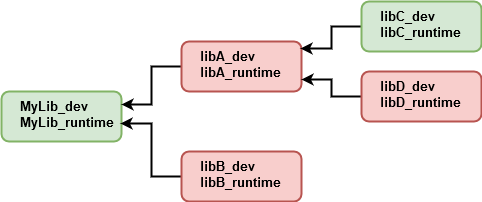
I am assuming here that all sub-projects are nice and assign their install components as dev/runtime. Red projects are _implementation details_ while green projects contribute to the public interface of MyLib. In my actual project there are a few more layers but **LibC** is something like `microsoft-gsl` and thier `gsl::span` is in the interface of **MyLib**. **LibD** is a wonky internal library that nobody would ever want to install into their system but is required for the internal workings of this larger library.
Given this project if I run `cmake --install .` then **ALL** 10 components are installed to the system. In reality a developer would only want
`cmake --install . --component MyLib_dev --component MyLib_runtime --component libC_dev --component libC_runtime`
(can we even have multiple component commands?)
Now consider if **MyLib** is actually **MyApp** and **LibA** is a shared library (forgive me for not redrawing). Then what we actually want to install is `cmake --install . --component MyApp_runtime --component libA_runtime`
This makes the `cmake --install` command hard to use correctly, and easy to use incorrectly. It seems like a useful feature would be commands similar to the cpack commands but for wrangling components for the install command. consider `cpack_add_component()` and it’s ability to add dependencies to a component. Consider the following hypothetical commands, where I am really just stealing CPack syntax
```auto
cmake_add_install_type(developer)
cmake_install_component(MyLib_dev
DEPENDS MyLib_runtime libC_dev
INSTALL_TYPES developer
)
```
then simply running `cmake --install . --component developer` or maybe `cmake --install . --type developer’.
---
### Author:  [@McMartin](https://discourse.cmake.org/u/McMartin)
#### Post date: [January 6, 2020, 8:20pm UTC](https://discourse.cmake.org/t/what-is-the-intended-use-case-of-the-install-command-line-option/452/5 "2020-01-06T20:20:54Z")
Install components are not equivalent to targets. Install components are defined using the `COMPONENT` keyword of the `install` command.
Instead of the hypothetical commands, you can use the following existing one:
```cmake
install(
TARGETS
MyLib_dev
MyLib_runtime
libC_dev
COMPONENT developer
EXCLUDE_FROM_ALL # excluded from a full installation
...
)
```
---
### Author:  [@CrustyAuklet](https://discourse.cmake.org/u/CrustyAuklet)
#### Post date: [January 7, 2020, 12:07am UTC](https://discourse.cmake.org/t/what-is-the-intended-use-case-of-the-install-command-line-option/452/6 "2020-01-07T00:07:10Z")
All the names listed in the diagram are install components, and so can not be grouped by listing them in an `install( TARGETS .. )` command.
Each cmake project/folder creates it’s install components. But then the “top” cmake file is stuck with those decisions?
Targets compose very nicely with PUBLIC, PRIVATE, and INTERFACE properties. CPack allows us group, hide, and create dependencies between components. The install command seems very underdeveloped in comparison. As a library/application author I want more control over the install experience of people downloading my library/application. I want to make it as simple and straightforward as possible for people to consume and install my project.
Unless I am not understanding the purpose of `cmake --install .` ?